
Label transparency · Supplement Facts
Soda Boost Formula Architecture
The Soda Boost supplement label names nine ingredients inside one 82 mg proprietary blend and prints an amount only for caffeine (5 mg). Here is the panel line by line, the most each ingredient can weigh, and what the label leaves out.
Updated November 7, 2026Transcribed from the seller's label image
The panel, transcribed
This is the Supplement Facts panel from the flat label image on the seller's page, read on November 7, 2026. Serving size: 1 gummy. Servings per container: 30.
| Line | Amount per gummy | % Daily Value |
|---|---|---|
| Calories | 10 | |
| Total Carbohydrate | 3 g | 1% |
| Total Sugars | 3 g | † |
| Includes 3 g Added Sugars | 6% | |
| Sodium | 4 mg | <1% |
| Proprietary Blend | 82 mg** | † |
| Muira puama extract | not stated | † |
| Maca extract | not stated | † |
| Catuaba extract | not stated | † |
| Green tea extract | not stated | † |
| Caffeine | 5 mg | † |
| Ashwagandha | not stated | † |
| L-arginine | not stated | † |
| Tribulus terrestris | not stated | † |
| Horny goat weed extract | not stated | † |
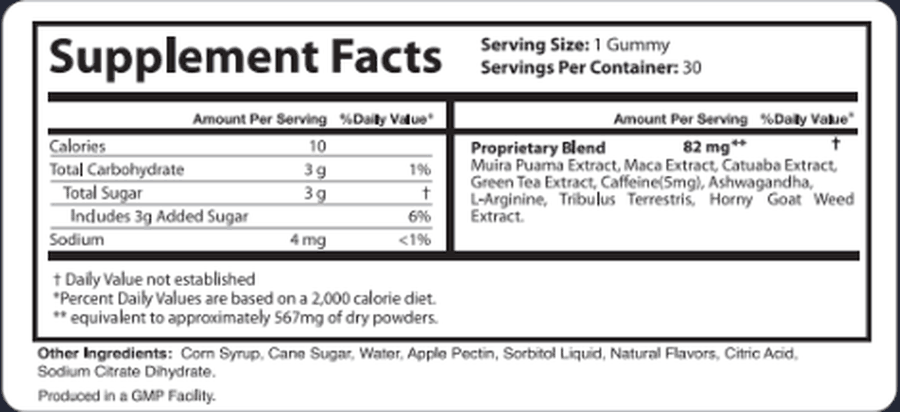
Blend arithmetic, step by step
A proprietary blend lets a company hide individual amounts, but federal rules still require descending order of weight[1]. One printed number inside the blend is enough to bound the rest:
- The blend weighs 82 mg in total, and caffeine, fifth in line, weighs 5 mg.
- Ingredients must be listed from heaviest to lightest, so the four after caffeine weigh 5 mg or less each (20 mg at most together).
- The four before caffeine therefore share between 57 mg (if the last four fill their 20 mg) and 77 mg (if the last four are near zero).
- Each of the first four must weigh at least 5 mg, because each outranks caffeine.
- Muira puama is heaviest only if it takes everything the others leave: 77 minus 3 × 5 = 62 mg. Maca can reach 33.5 mg only by tying with muira puama ((77 − 5 − 5) ÷ 2). Catuaba tops out at 24 mg ((77 − 5) ÷ 3), green tea at 19.25 mg (77 ÷ 4).
- These are ceilings. A realistic split, say 30, 20, 15 and 12 mg for the first four with about 5 mg spread across the last four, is just as consistent with the label.
The 567 mg footnote
The double asterisk says the 82 mg is “equivalent to approximately 567 mg of dry powders”. That is an overall concentration of about 6.9 to 1. It tells you the extracts are concentrated on average, not which ones or by how much. Studies are dosed by named extract or by dry root weight, so even this generous reading cannot be mapped to any one trial. Read literally, it still puts the plant-weight equivalent of the whole blend below the 1,500 mg of maca root used in the lowest positive trial[2].
Other ingredients and what they do
| Ingredient | Role in the gummy | Worth knowing |
|---|---|---|
| Corn syrup, cane sugar | Bulk and sweetness | Supply the 3 g of added sugar (6% DV); about 90 g a month[3] |
| Water | Gel medium | Evaporates partly during setting |
| Apple pectin | Gelling agent | Plant-based; no gelatin is listed |
| Sorbitol liquid | Moisture and texture | Large amounts can loosen stools; one gummy holds little |
| Natural flavors | Taste | Composition not disclosed, as the law allows |
| Citric acid, sodium citrate dihydrate | Tartness and pH buffer | Source of most of the 4 mg sodium |
What the label leaves out
- Species and plant part for every botanical. Catuaba is the clearest problem: several unrelated barks are sold under that name[4].
- Standardization markers such as icariin (horny goat weed), EGCG (green tea) or withanolides (ashwagandha), the compounds studies measure.
- Extract ratios per ingredient; only the blend-wide 567 mg footnote exists.
- The manufacturer. “Produced in a GMP Facility” names no company or city; the label names the distributor, Instituto Experience, Lakeland, FL 33804.
Cost per milligram
At $1.63 a day in the 6-bottle pack you pay about 2.0 cents per milligram of blend; in the 2-bottle pack, $2.80 a day, about 3.4 cents. That figure matters less than the dose gap, but it explains why the price per day looks modest: you are buying a small amount of material.
Sources
- 1Electronic Code of Federal Regulations. 21 CFR 101.36: Nutrition labeling of dietary supplements.
- 2Gonzales GF, Córdova A, Vega K, et al. Effect of Lepidium meyenii (MACA) on sexual desire and its absent relationship with serum testosterone levels in adult healthy men. Andrologia. 2002;34(6):367-372.
- 3Johnson RK, Appel LJ, Brands M, et al. Dietary sugars intake and cardiovascular health: a scientific statement from the American Heart Association. Circulation. 2009;120(11):1011-1020.
- 4Kletter C, Glasl S, Presser A, et al. Morphological, chemical and functional analysis of catuaba preparations. Planta Med. 2004;70(10):993-1000.